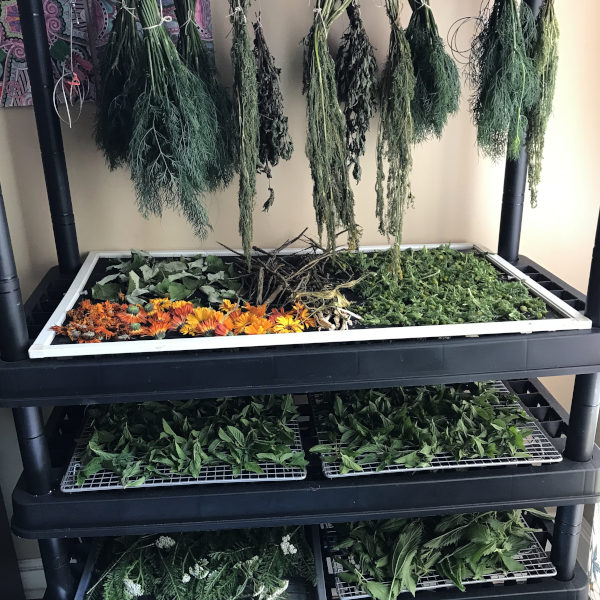
During summer and fall, the shelves I start seeds on turn into drying racks for various herbs. Drying herbs is a great way to store them when freezer space is a hot commodity. Dry herbs do not use costly electric power for storage. Drying is also a reliable storage method if the power goes out.
My grandmas and mom were not into drying herbs. Actually, Mennonites are not known for their array of herbs. Many famous Mennonite dishes are white, flavoured with salt and pepper, or fried in fat. “If it’s not fried, it’s not food,” my grandpa says, only partially in jest. Summer savory and dill are some exceptions. These my family has stored in ziplock bags in the freezer.
Drying Herbs
Don’t get me wrong, freezing herbs is a quick and handy way to get herbs into storage if you don’t have time, or humidity or impatience is against you. These days, air conditioning in many people’s homes helps remove humidity.
Herbs are a wonderful way of eating a variety of greens with a variety of vitamins, not to mention many with antimicrobial properties.
Last year I ran out of spearmint and dill first, (Can you say, “honey dill sauce”?!) so I’m adjusting the amount I am drying. I also collected more stinging nettle, and earlier in the season, before it seeds, and before the insects get it. I guess they know it’s good for them too.
This year I’m doing multiple cycles of drying, according to plant readiness, and space. This includes dill, spearmint, giant hyssop, calendula, dill, pineapple weed/ wild chamomile, yarrow, stinging nettle, dill, dandelion flowers and roots, willow bark, sage, summer savory and golden rod. Did I mention dill?
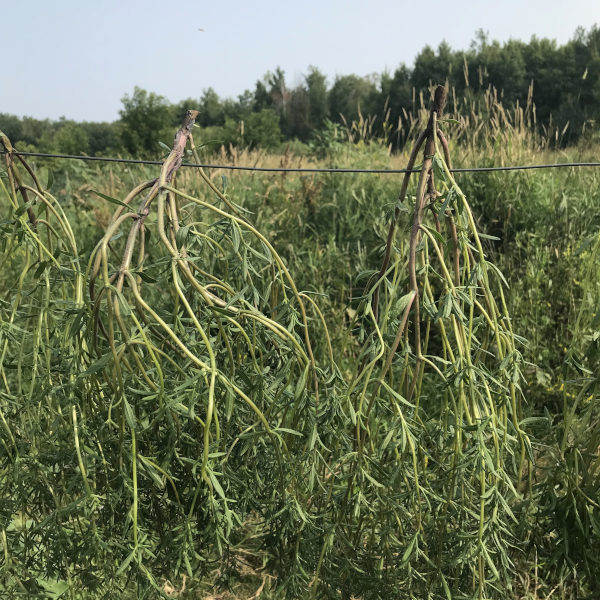
If you’re thinking, “how does she fit all that in her house?” I don’t. If the forecast is fair and dry, outdoors is a great place to hang herbs, on a tree or fence, or line. There is plenty of room and great ventilation. However, they CAN NOT be strung in the sun for an extended period of time. Any farmer will tell you that hay must be baled within a few days or it will turn brown and useless. I am not a good farmer. Oh dear. So, either bring the herbs in to finish drying after the initial wilt, or keep them out of the sun!
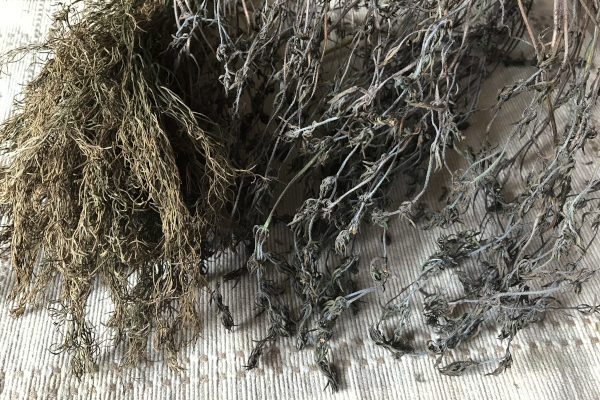
Indoors, I either hang bunches of herbs or lay them on screens, drying racks, or even cooling racks for baking, in a single layer. A fan is helpful to keep air circulating. A dehydrator might be a handy alternative.
There are some herbs not suitable for drying. Plants with thick leaves, such as purslane, kale, spinach or swiss chard do better in the freezer. Some sources say basil is difficult to dry as well, but I dried a couple of dozen plants last year in my basement, of all places, under a fan, and it was great. And no, I did not need more basil this year!
Herbs are ready to store in a jar in a dark pantry when the leaves crack instead of bend, usually two to four weeks. Hanging herbs can be pretty, but they collect dust, and volatile oils can evaporate. I pack jars, but keep leaves whole for the same reason – to keep essential oils in the leaves until I need them. These herbs will keep well for about a year or two.
Oh, my grandma! When they moved off the farm, she gave me a jar of basil (among many other things). But those Mennonites not using their herbs – it was so old it smelled dusty. I kept the jar.
Well, I should go put some herbs in jars and collect some goldenrod to replenish the racks!
 I'm Erika, I live on eighty acres in the northern prairies of southern Manitoba with my husband and four kids. Here, we enjoy the outdoors and try to be more self sufficient as we try new things in the garden and learn about our land and the world around us.
How fortunate that you can make your own spices, and in such quantity!
It can be interesting collecting and growing food for a family of six:)